Introduction
Over forty years of practice, I noticed something that surprised me. The patients and colleagues who made the best decisions were not always the smartest people in the room. And the ones who made poor decisions were rarely lacking in intelligence. What separated them was not how much they knew, it was how they thought when the information was noisy, the stakes were high, and the pressure was on.
I saw people trust the wrong source because it sounded confident. I saw careful people accept weak evidence because it matched what they already believed. I saw smart people rush a decision they later regretted. And I saw the opposite, too: people who paused, asked better questions, and reasoned their way to good outcomes without any special expertise.
Over time I realized these were not random differences. Clear thinking is a skill, and like any skill, it can be broken down, learned, and practiced.
I am a physician. I have practiced in both the hospital and the office, sitting across from thousands of patients as they made some of the most important decisions of their lives.
Medicine is supposed to be grounded in science, evidence, and clear reasoning. If clear thinking were going to come naturally anywhere, it would be there. It did not. I watched intelligent people, doctors and patients alike, fall into the very same traps as everyone else, and in clinical practice a single misjudgment can change the course of someone’s life.
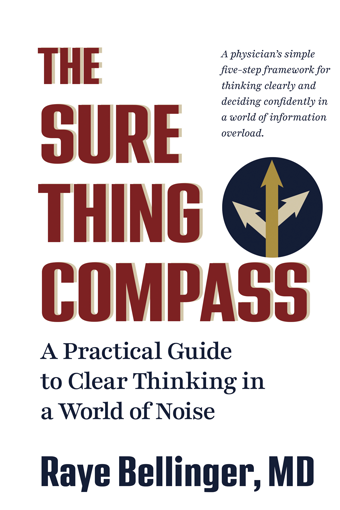
So I built the Sure Thing Compass for myself: a simple, reliable framework I could use under the pressure of a busy office and hospital rounds. Nothing in this book is theoretical. It is what I actually did.
I have kept it short on purpose. You should be able to read it in a few hours, or over a single weekend. And whether you are a physician, a teacher, a parent, a business leader, or simply someone who wants to think more clearly in a chaotic world, these tools are for you.
What you will have at the end is not another set of facts. It is a repeatable method, one that can improve not just your own life, but the lives of those who depend on you.
Because in the end, clear thinking isn’t just an intellectual skill. It is a responsibility: to ourselves, and to everyone whose lives are touched by the decisions we make.
Welcome to The Sure Thing Compass.
Chapter 1
The Power of the Pause
I learned the importance of the pause the hard way: through forty years of clinical practice.
Early in my career, I would walk into an exam room and feel the pressure to have an immediate answer. Patients wanted solutions. Families wanted certainty. The natural instinct was to speak quickly, act fast, and appear confident. But I soon discovered that my quickest responses were rarely my best ones.
The pause is the most foundational and yet most neglected skill in clear thinking. In our fast-paced world, the ability to intentionally create a brief space between stimulus and response has become revolutionary.
The Neuroscience Behind the Pause
When we encounter a strong emotional trigger (a frightening diagnosis, an alarming news headline, or an angry message), our brain’s amygdala activates the fight-or-flight response. This ancient survival mechanism floods our body with adrenaline and cortisol, narrowing our focus and impairing rational thinking.
The pause is the critical bridge that allows our prefrontal cortex, the part of the brain responsible for reasoning, planning, and self-control, to catch up. Even a few seconds can mean the difference between a knee-jerk reaction and a thoughtful response.
The Cost of Not Pausing
In medicine, failing to pause can lead to misdiagnosis, unnecessary procedures, or poor treatment choices. Outside of medicine, the consequences are equally real: angry emails we regret sending, impulsive purchases, damaged relationships, and beliefs formed on incomplete information.
I have seen patients make life-altering medical decisions in a state of fear or panic. I have also watched intelligent people share medical advice on social media within minutes of reading a headline, often spreading fear or false hope without realizing it.
A Woman Who Did Not Feel Sick
A woman came to see me because her primary care physician had sent her. That was, as far as she was concerned, the entire reason. She had no complaints she was willing to name. When I asked what she understood about why the appointment had been made, she said she wasn’t exactly sure: he had felt something might be wrong, and she had come because he asked her to.
The evaluation showed coronary artery disease severe enough to consider bypass surgery.
I told her what we had found. And somewhere in the middle of it, I watched her leave the room without moving.
“I’m okay,” she said. “I don’t feel bad.”
She said it again a few minutes later, and again after that. It was not an argument. She was not disputing the findings, or asking about the evidence, or wanting to know the numbers. She was holding on to the one fact that still felt like hers: she had walked in under her own power, on an ordinary morning, feeling fine.
Everything I said after that landed on a person who was no longer able to hear it. Her body was doing exactly what I described above: narrowing her focus, flooding her system, shutting down the machinery she needed most. She had come in for someone else’s reason and been handed the worst news of her life, and now a stranger was asking her to agree to have her chest opened.
I would like to report that I met this with perfect patience. I did not, and I want to be precise about why, because it was not simple irritation.
I knew what was on the films. I knew what happens to people with that degree of disease who go home and do nothing. Every minute she spent not deciding was a minute she spent at risk, and I was the only person in the room who fully understood that. The pull to press for a signature that afternoon was not impatience with her. It was fear for her.
This is the part that rarely gets said about pausing: it is not free. Waiting has a cost, and sometimes the cost is measured in something worse than an awkward email. Anyone who tells you the pause is always the right move has never had to weigh it against a real risk.
What decided it for me was not patience. It was a judgment about what pushing would actually buy. A person who has gone underwater does not say yes under pressure: she says no, and then she leaves, and then she does not come back. Pressing her that afternoon would not have gotten me a decision. It would have gotten me a refusal, and probably the last one she ever made on the subject.
So the choice was never between acting and waiting. It was between a small, known risk of a few more days, and a large risk of losing her entirely. I took the smaller one.
I told her the disease was not going to change over a few days, that she was safe to go home, and that she should come back when she was ready to talk about it, and that she should bring someone with her.
She came back with her daughter.
The second conversation was not a different conversation. It was the same information, in the same room, from the same doctor. What had changed was that she could hear it. She asked questions. She wanted to know what would happen if she did nothing. Her daughter asked the things she couldn’t. By the end she was not enthusiastic (nobody is enthusiastic), but she was present, and the choice was actually hers.
She had the surgery.
I think about that afternoon whenever I am tempted to mistake speed for care. Nothing I said in the first conversation was wrong. It was spoken to someone who could not receive it. The pause did not change the medicine. It changed who was making the decision. Chapter Five will give that afternoon its proper name: a decision both high in stakes and hard to undo, which is the one category where waiting almost always costs less than it looks like it will.
And that is the part worth carrying out of the exam room. Sometimes the pause is not something you take for yourself. It is something you give to another person (a spouse, a colleague, a frightened parent) by declining to demand an answer from them at the worst possible moment.
Why Modern Life Works Against the Pause
Today’s environment is specifically engineered to eliminate the pause:
- Smartphones deliver instant notifications.
- Social media rewards rapid reactions.
- News outlets compete on speed rather than accuracy.
- Artificial intelligence gives instant answers before we’ve even finished thinking.
We have become conditioned to react rather than reflect.
Practical Techniques for Mastering the Pause
- The 30-Second Rule. When you feel a strong emotional reaction, commit to waiting thirty seconds before responding, sharing, or deciding. Use that time to take one deep breath and ask yourself: “What am I actually feeling right now?”
- The Emotional Labeling Technique. Simply naming the emotion you’re experiencing (“I’m feeling anxious,” “This is making me angry,” or “I’m scared”) reduces the intensity of the emotion and creates mental space.
- The One-Breath Method. Before replying to any important message, email, or question, take one slow, deliberate breath. This micro-pause can dramatically improve the quality of your response.
- Environmental Design. Turn off non-essential notifications, create buffer zones in your day, and remove the temptation to react instantly.
- The Nighttime Rule. For any important decision (medical, financial, or personal), sleep on it when possible. The perspective gained overnight is often remarkable.
A Moment You Will Recognize
An email arrives. Your name is in it, and so is a mistake you did not make. Two colleagues are copied. Your face gets warm and your hands are already on the keyboard, composing the reply that sets the record straight.
This is the moment. Not an hour from now, when the damage is done, right now, with your fingers on the keys.
Notice what is actually happening in your body. Your heart rate is up. Your focus has narrowed to a single point. You feel the pull toward a fast, forceful response. That pull is not judgment. It is chemistry.
So you take one breath. You name it: I am embarrassed, and I want to defend myself. Then you set the message aside for an hour.
When you return, you notice the sentence you were about to write would have made an enemy over a misunderstanding. The reply you send instead takes ninety seconds and costs you nothing. Nobody ever knows what you almost sent. That is what the pause looks like: not dramatic, just quietly decisive.
The 7-Day Pause Challenge
I encourage every reader to commit to this simple challenge: For the next seven days, keep a brief log every time you successfully pause before reacting. You will likely be surprised by how often you catch yourself, and how much better your decisions become.
Where This Leaves You
The pause is the foundation upon which all other steps of the Sure Thing Compass rest. Master this step, and everything that follows becomes much more powerful.
Your move this week: The next time you feel the urge to respond immediately (to a message, a headline, or a person), wait sixty seconds and name the emotion before you act.
Keep reading