Introduction
There is a puppy in the backyard. He is fed on time. His water bowl is never empty. He has a warm bed, a basket of toys, and a family that adores him. Every need he has ever had was met before he finished feeling it.
One day you call him to heel, and he looks at you. Not defiant. Not stubborn. Blank. He does not come, because nobody ever taught him to come, and because until this exact moment nothing has ever been asked of him.
I have spent forty years as a physician, and most of that time I have spent watching people decide things under pressure. Somewhere in the middle of those years, the conversations in my exam room started to change. Parents began bringing me their grown children (eighteen, twenty-two, twenty-six) and asking me, in one form or another, the same question. He is healthy. He is smart. He is kind. Why can't he start anything?
Here is the cruel part, and I want to say it first, before anything else in this book can be misread. Those parents did everything right. They strapped their children into the five-point harness. They cut the grapes lengthwise. They drove to the tournament at six in the morning in the rain. They emailed the teacher about the grade. Every one of those choices was love. Not one of them was a mistake in isolation.
But love poured in as pure comfort, with the friction taken out, the struggle removed, the fall broken every single time, does something none of us intended. It sands the drive right off them. Not through neglect. Through its opposite.
And then you are standing in your kitchen looking at a capable, well-fed, perfectly pleasant young adult who cannot seem to begin. And the word that arrives in your mind, unbidden and awful, is lazy.
This is where I am going to ask you, as a physician, to stop.
Lazy is not a diagnosis. Lazy is what we call it when we have not looked yet. Won't and can't look identical from across a room, and they look identical from across a kitchen too. Before anyone in this book says a word about character, we are going to do what I would do in the office: rule things out. Depression. Anxiety. Thyroid. Sleep. Attention. We earn the right to the harder conversation, and we earn it by looking first.
I have organized this book the way a repair manual is organized, because that is honestly how I think. First the diagnosis: what is actually wrong, and how to tell one thing from another. Then the mechanism: why it happens, what is driving it, what the system underneath is doing. Then the treatment plan, along with its limits.
I want to be plain about that last part. This is not a cure, and I will not sell you one. You cannot install drive at eighteen the way you would flash new software onto a machine. What you can do is start. You can stop rescuing. You can put small struggles back in on purpose, in doses your family can actually survive. That tilts the odds. In medicine, tilting the odds is most of what we do, and it is not nothing.
One more thing, and it matters more than anything else I will say. This book is written for you, the parent. Not for your child. It is not a document to leave on the kitchen counter open to a page you want somebody to read. It is not ammunition. If it becomes that, I have failed, and so has it.
Because the thing about the puppy in the backyard is that nobody blames the puppy.
Chapter One
The Puppy in the Backyard
Somebody brings home a puppy. Golden, floppy, eight weeks old, and the whole family falls in love in about four minutes. They buy the good food. They buy the orthopedic bed, which is a thing that exists now. They buy a basket of toys that will end up under the couch. The dog is fed on schedule, watered, kept warm, and driven to the veterinarian the first time he sneezes.
He wants for nothing. And everyone assumes that the rest of it (the manners, the coming when called, the not destroying the arm of the sofa) will simply arrive in its own time. Because look how much we love him.
Then the dog is a year old, and he bolts out the front door every time it opens. He puts his paws on the grandmother. He does not come when called, not once, not ever, and the family is genuinely baffled by it. We gave him everything, they say.
And they did. They gave him everything except the one thing that was actually hard, which was the training. Comfort, you can buy at the store. Obedience and drive, somebody has to sit down and build, in small repetitions, over months, at exactly the moments when it would be easier not to.
Now here is the part I find most revealing. Nobody blames the dog. Not one person in that house says the dog is lazy, or ungrateful, or a disappointment. Everyone understands, without being told, that an untrained dog is an unmanaged dog and not a bad one. We extend the animal that grace automatically, and we extend it without resentment.
We do not always extend it to our children.
Hold that image and change only the subject. We bring home a child. We give that child everything we can afford and a good deal we cannot. Comfort. Safety. Entertainment on demand. The smoothing over of every hard edge we can reach. We are attentive the instant something hurts, and we are proud of that attentiveness, because it is the visible evidence of our love.
The child wants for nothing. And we assume the rest of it (the drive, the follow-through, the ability to sit inside something difficult without fleeing it) will simply arrive in its own time. Because look how much we love them.
Then they are eighteen, and the switch is supposed to flip. We expect initiative. We expect grit, a work ethic, some kind of plan. And when it is not there, we are genuinely baffled. We gave them everything, we say.
And we did. We gave them everything except the one thing that was actually hard.
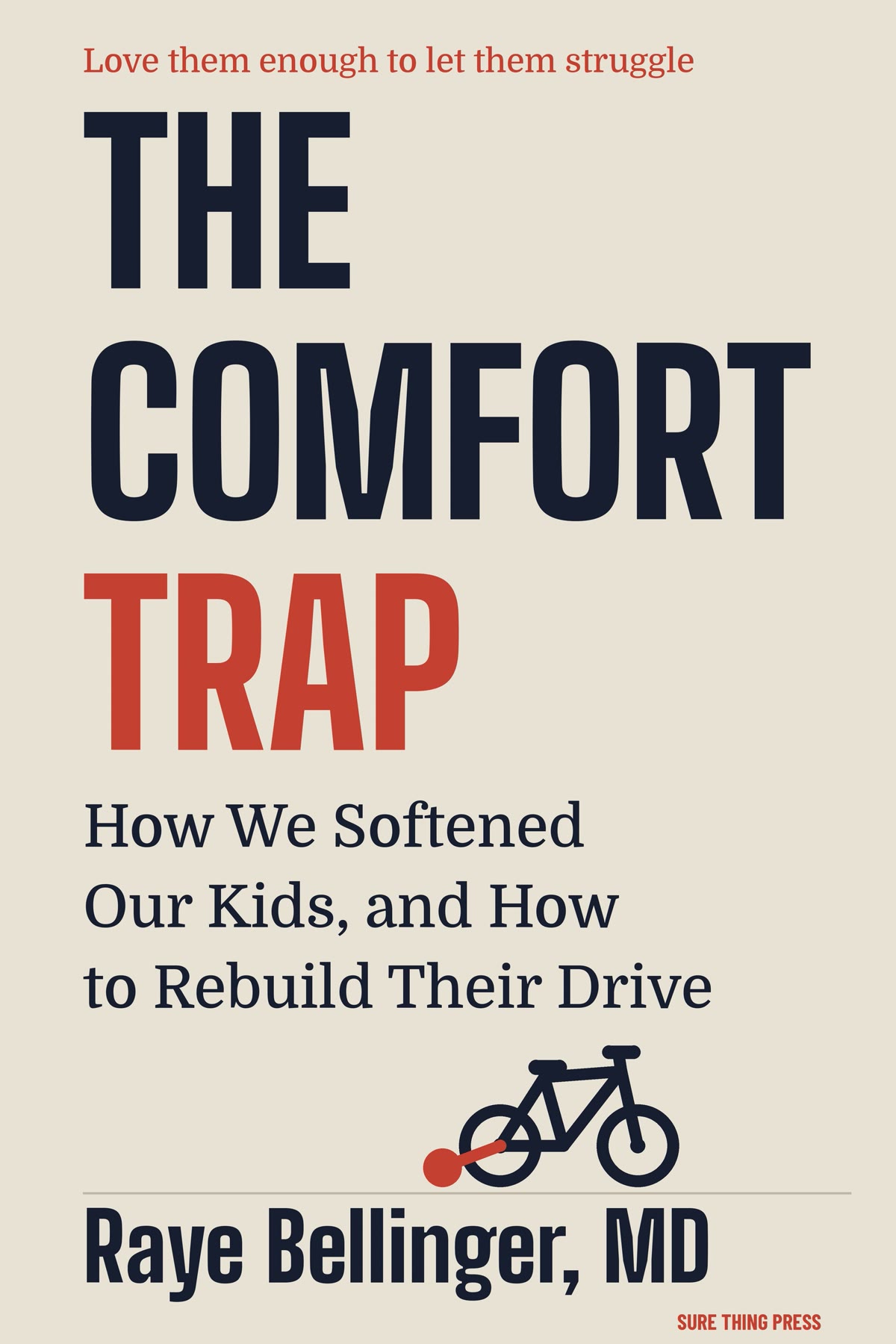
That is the comfort trap. It is not neglect. It is the opposite of neglect, which is exactly what makes it so difficult to see and so painful to admit. It is what happens when love expresses itself entirely as the removal of difficulty, and difficulty turns out to have been the nutrient the whole time.
I want to be careful here, because there is a version of this argument that curdles into contempt, and you have heard that version. It usually comes with a story about walking to school in the snow. That is not what this is. The parents I am describing are not weak or foolish. They are, by every measure they were given, excellent parents. They optimized for the thing they were told to optimize for. The trouble is that nobody told them what the optimization was costing.
* * *
A colleague of mine had a son who wanted to go to the college his father had attended. The boy was bright, his record was strong, and he had every reason to think he would be a good candidate.
His father had a reason to think the matter could be helped along. The dean of admissions at that college had been his classmate. One phone call would have given his son a friendly ear. Most people in his position would have made that call without thinking of it as a favor at all. It would have felt like simply being a good father.
He did not make it. He did not call the dean, he did not write a letter, and he did not help with the application. He told his son that he had gotten into that school by working hard and on his own, and that his son would get there the same way. You are on your own.
His wife was upset, and she said so. "He is smart and will do fine," she told him. "He does not need the hassle."
I want to be fair to her, because she was not wrong about the boy. He was smart, and he probably would have done fine either way. What she objected to was the months of applying and waiting and not knowing, when a single call might have spared him all of it. That is the comfort trap in its most reasonable voice. It never says, make my child weak. It says, why put him through this when he does not need it?
The son was accepted, the same way his father had been.
Here is what the phone call would have cost, had it been made. Not the admission; he earned that anyway. It would have cost him the knowledge that he earned it. Whenever he wondered whether he belonged there, there would have been a quiet question underneath: did I get in, or did my father get me in? By refusing to help, his father took that question away before it could form. The hassle was the gift, and so was the proof that he could get through it.
* * *
So this book is about how that happens, why it is so easy to do, why it is nearly invisible from the inside, and what can still be built once you see it, including late, which is when most of us see anything.
And it starts where every honest assessment starts. Not with a verdict. With a question.
Out now